Agents read 1,142 tokens for every token they write, and premium models bill the most for each one
In one week of GitHub Copilot traffic, Microsoft counted 44.9 trillion tokens going into the model and 39.3 billion coming out. That is about 1,142 tokens read for every token written calc. The median turn carried 227,600 tokens of input.
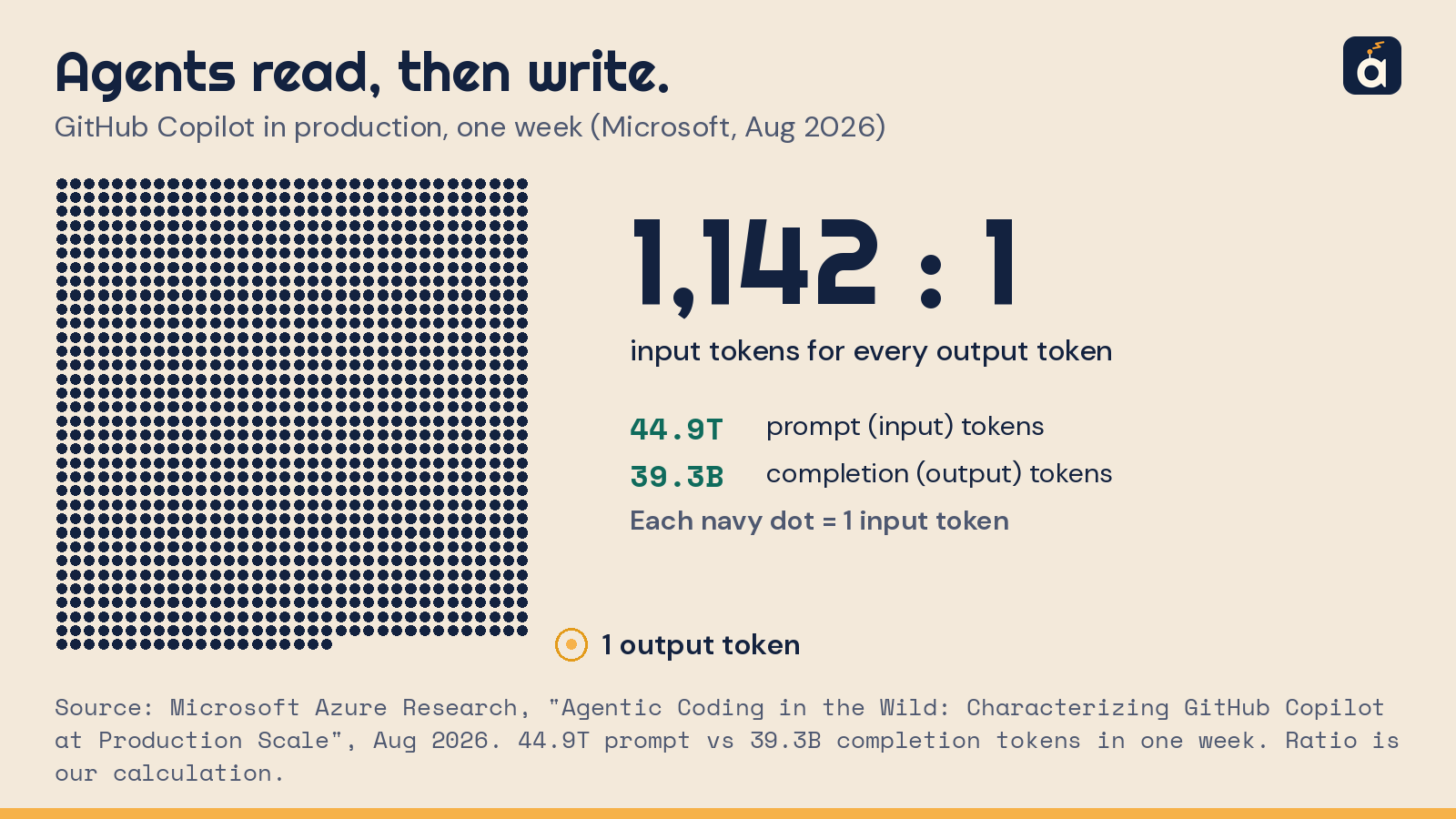
Agents spend most of their budget on what they read. That matters because of which models are doing the reading.
Tokens got cheaper. The expensive work did not move.
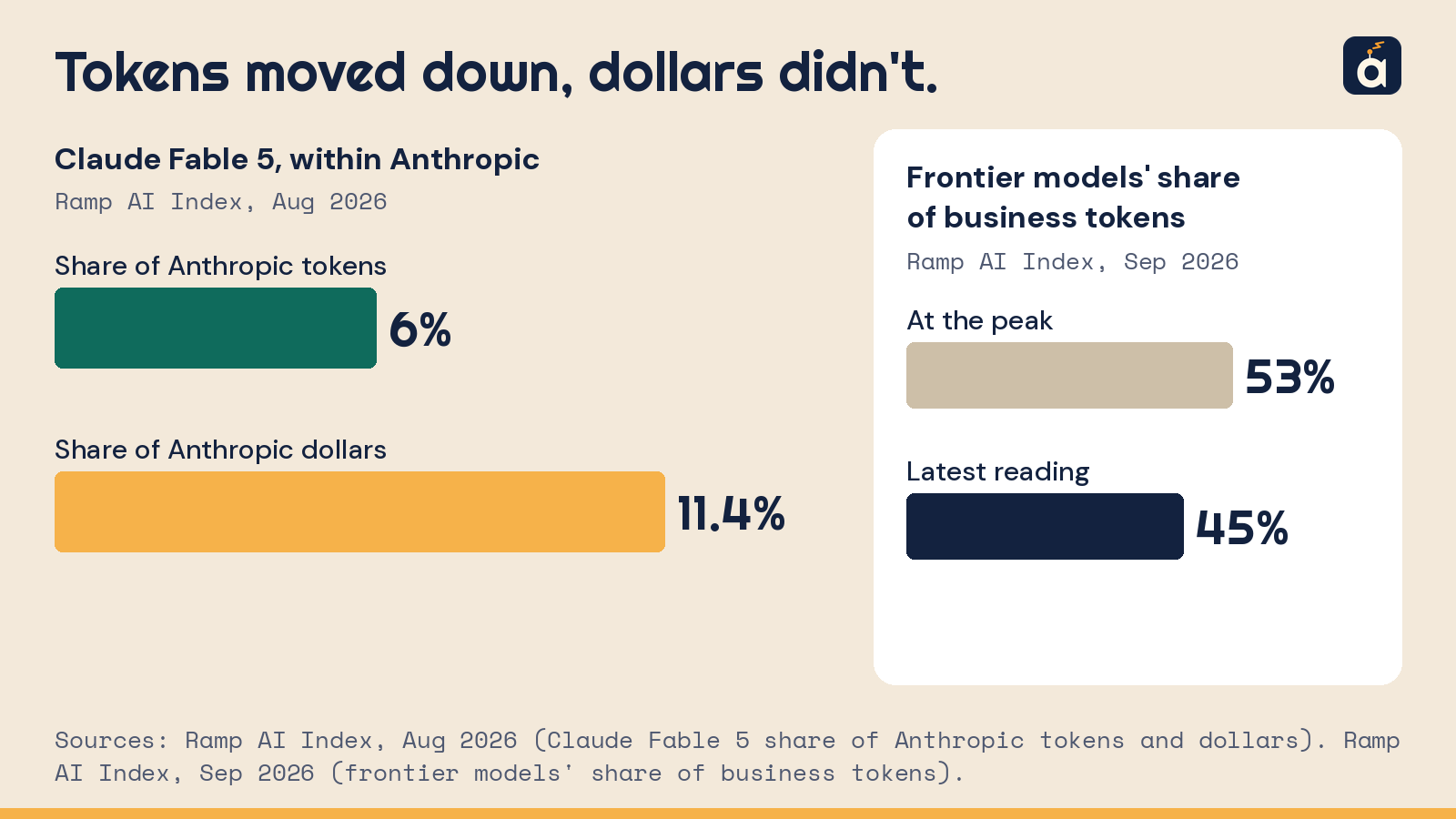
Ramp tracks AI spending at more than 70,000 US businesses. In October 2026, it reported that token volumes rose while token spending stayed flat. Businesses are buying more tokens for the same money.
Most of the extra volume goes to cheap standard models. In Ramp's September index, frontier models had fallen from a peak of 53% of business tokens to 45%.
The dollars did not follow. On Ramp's August data, Claude Fable 5 was 6% of the Anthropic tokens businesses bought, but 11.4% of the Anthropic dollars.
Demand barely responds to price. OpenRouter and a16z found that a 10% price cut brings only about 0.5% to 0.7% more usage. Anthropic's Economic Index found that the tasks businesses run most are the ones that cost more.
The expensive work is coding and agents. Menlo Ventures puts Anthropic's share of enterprise coding at 54%. Bulk work goes to cheap open models. The input-heavy work stays on the models that cost the most to read with.
One page, read 1,000 times
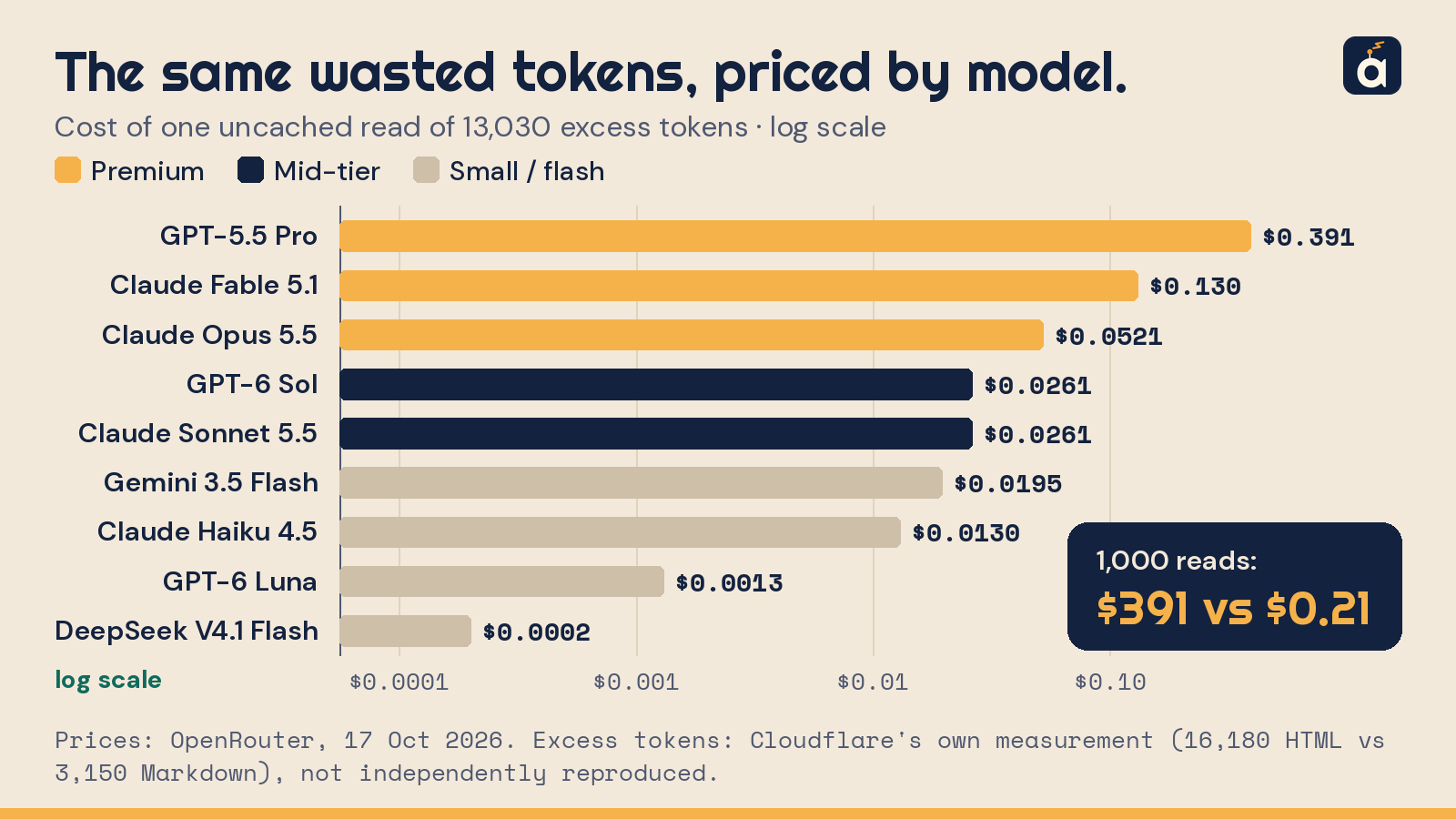
Cloudflare measured its own launch post at 16,180 tokens as HTML and 3,150 as Markdown. The 13,030-token difference is markup the model gains nothing from.
At OpenRouter's published input prices on 17 October 2026, reading those extra tokens 1,000 times costs $391 on GPT-5.5 Pro. On DeepSeek V4.1 Flash, it costs $0.21 calc.
The waste is identical. The bill differs by a factor of more than 1,800, because GPT-5.5 Pro charges $30 per million input tokens and DeepSeek V4.1 Flash charges $0.0161.
Where the tokens leak
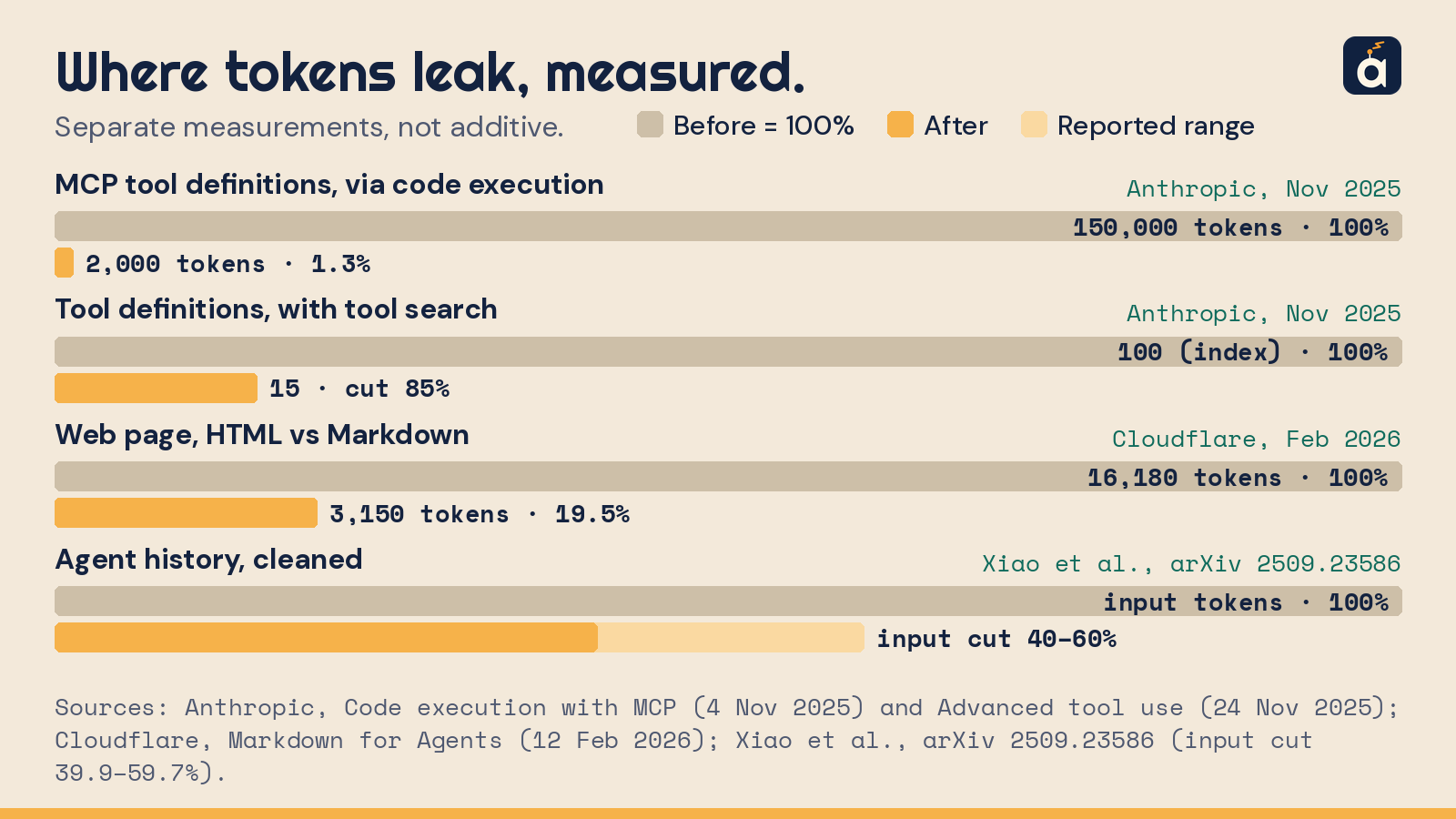
Third-party measurements point to five recurring leaks:
- Agent structure. Anthropic found that agents use about 4 times the tokens of chat, and multi-agent systems about 15 times.
- Retries. In the Copilot traces, tool failures hit 9% of turns and retry loops amplified compute up to 4 times.
- Tool definitions. Anthropic measured about 55,000 tokens of tool definitions loaded before any work starts in a five-server setup.
- Stale history. One study removed redundant and expired content from agent trajectories and cut input tokens by 40% to 60%, with no loss in performance.
- Raw formats. HTML, full logs, whole specs and whole repositories go into context unprocessed.
Where shortcuts fit
A pay-per-use shortcut does the bulk part of a read with plain code or a small specialist model. It returns a shorter result, so the premium model spends its expensive input on the part of the task that needs it.
Amazap's shortcuts target the raw-format leak:
- Log Squeezer shrinks a failed CI log before an agent reads it.
- Docs Digest returns an outline, signatures and examples from a large documentation site.
- API Spec Digest turns an OpenAPI spec into a compact endpoint index.
- Repo Digest returns a repository's structure, entry points and recent commits instead of file-by-file reads.
- Package Facts returns a package's advisories, deprecations and upgrade path.
- PDF reading converts PDFs to Markdown for agents that cannot run a local converter.
The limit is plain: if your agent already strips pages to clean text, or runs on a cheap model, a shortcut adds little, and we do not publish savings figures until we have measured them against that clean-text baseline.
The full research, with every source and method, is here: Business token usage: the full research
Sources:
- Microsoft Azure Research, Copilot traces (Aug 2026)
- Ramp AI Index (Aug, Sep and Oct 2026)
- OpenRouter and a16z, State of AI (Dec 2025)
- Anthropic Economic Index (15 Sep 2025)
- Menlo Ventures (9 Dec 2025)
- Cloudflare, Markdown for Agents (12 Feb 2026)
- OpenRouter models API (17 Oct 2026)
- Anthropic engineering posts (13 Jun 2025, 24 Nov 2025)
- Xiao et al., arXiv 2509.23586 (2025)
Full links are in the research page.
- Our arithmetic on the cited figures.